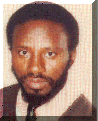
A BRIEF
SKETCH OF MY BIOGRAPHY AND THE ROAD LED ME TO N’KO SCHOOL
I was born on the
14th of April 1957 in Jasobo Village, Lower River Division (now
Lower River Region), in the Gambia. I am father to three healthy children, a
boy and two girls. I am the first born of my father's three children, and
the sole surviving child of my mother, Faye-Nyamokono Dampha. My father,
Kabba Tilibonka Jammeh, was an Islamic scholar, who died in Banjul in 1973,
the very year he should have graduated in order to complete his
theological studies from the well-known Islamic institute
Majiliso, owned and led by Foday Kabba Barrow of Kiang Bambako, in the
Gambia. Shortly after my father’s death, his younger brother, uncle Fodayba
B Jammeh, who then was police officer, took the role as the prime warden of
me and my junior brother Kebba.
As can be
discerned from my age above, I was not born when Fode Suleman Kante
(1922-1987)
of Guinea created the N’ko Alphabet in 1949. Thirty- three years after the
inception of its alphabet, I stated to learn the written form of my
own language, N’Ko, in 1979, when I already could read and write in the
foreign languages English and Arabic.
On the 24th
of April 1979, at the age of 22, I started my long journey to seek for a
better future. The Jahiria Arab Republic of Libya was then the
lucrative place for many African youths who search for economic prosperity,
and so I also decided to go there. After a week and half of travelling by
car, I arrived on the Niger/Burkina frontier where I encountered my first
obstacle. I was hindered by border guards to enter into Niger because I
refused to bribe them, when they asked me to pay them an unthinkable amount
of money in CFA Francs, which they did not deserve. To justify the bribery,
they claimed that I had no entry visa into Niger. I was not surprised by
their demand because bribery is an un-written law, which the majority of our
men-in-uniform apply on people before giving them their so-called
permission, even in a minor case as I just mentioned above. As I was not
ready in bestowing them the entire amount they asked me to pay, I tried a
kind of persuasion by offering them just one quarter of the amount they
asked me. Despite all the appeals I made to them, the greedy officers
declined to let me in. "If you don’t pay, we will deport you to Gambia” was
their reply. Such intimidating words, uttered in an arrogant manner, had not
shaken my nerves but turned my mood into anger instead. I reminded the
commanding officer about the ECOWAS Charter of free movement of its citizen.
The Gambia and Niger being members of ECOWAS. In fact, I said “As a citizen
of ECOWAS, I don’t need to have a visa to enter in any ECOWAS
country”. Had I known, I would not have said that. The moment I pronounced
those words, sooner said than done, the officer in charge urged the lorry
driver to extract my sole belonging, a travelling bag, from the lorry. Then
the driver was then told by a junior officer to start the lorry and get off
the site. The lorry proceeded with the other passengers and left me behind,
stranded at the border.
On
‘no-man’s-land’, I spent the longest night of my life on the border. Alone!
The following morning, I took a car heading back towards Ouagadougou, the
capital city of Upper Volta (now Burkina-Faso). From there I continued to
Bobo Dioulasu, the city I disembarked from two days earlier. By the time I
arrived in Bobo Dioulasu, I was financially broke. Luckily for me, a
gentleman and I can also add a true philanthropist whom I met offered me
free accommodation. With no cash or any valuables I could use to survive, I
was left with no other option other than to take any kind of work as the
source of my living. I asked my ‘guardian philanthropist’ about
possibilities of work and where I can get gainful employment. He told me
that he would discuses my case with a good friend to his, a big inter-city
merchant who shuttles goods between Abidjan-Accra-Bobo Dioulasu. I was so
encouraged by my guardian when he told me the following words, “My friend,
i.e. the trader, would like to have someone like you to travel with
him to Ghana. He always needs help with translation. He travels to Ghana now
and then, to purchase water pumps and other equipments which are very much
profitable goods here in Bobo Dioulasu. When he travels there, he used to
have someone to act as his interpreter. He would surely need you there, he
added”.
With my new boss,
I made my first journey to Kumasi in Ghana in September 1979 and on that
trip I noticed how my boss appreciated the little knowledge I have
acquired in the English language. After few trips to Ghana, which brought in
less profit than he expected, my boss suggested Lagos, in Nigeria, the
biggest trading centre in the region, i.e. West Africa. This time, he, my
boss wanted to engage in the Honda CC125 motorbike business.
On November 16th
1979, my boss and I were departed from Bobo Dioulasu to Lagos. Immediately
after our arrival in Lagos, we went to “the money exchange office”, the
“black market”, and exchanged his CFA Francs into the local Nigerian
currency, the Naira. To know the equivalent price of items from Naira to
CFA, I helped him by acting as accounting clerk and simultaneous translator
between him and shopkeepers. Together, we bought all what he wanted and
could buy, before I revealed what I had in my mind that I preferred not to
follow him to Bobo Dioulasu but to stay in Lagos. I promised to help him
again if he happens to come back and meet me in Lagos. We lodged in a hotel
in the heart of Logos business centre. A few days after my boss left, I got
a job not where we were lodged but at a nearby Hotel. I was rather satisfied
with my new job. Within the period of 6 months, I secured the full
confidence of the hotel manager, a Mr. Geoffrey William, a British citizen.
I was promoted and transferred to another hotel in the small Nigeria/Benin
border town called Idiroko. There I became a deputy to the head
receptionist. I held that post until 1983, the year the military, headed by
General Mohammed Buhari, toppled the civilian government of President
Sheihou Shagari, and ordered the mass deportation of all illegal
aliens. Due to the fact that I had a working permit, I was not directly
affected by the deportation. But a big blow came to me soon after the new
regime ordered the printing of new Naira notes. All my savings became in
vain after the juntas came with degrees that the new Naira notes would
replace the old one and the old one would be changeable in a period of 30
days only. And what more, only the amount of money that has been
deposited in the bank was changeable with the new notes. For non- Nigerian
citizens like me, who had the valued resident permit, were allowed to
deposit or withdraw only 2000 Naira.
Nationwide, panic
broke out when it was announced that the amount of new Naira notes, which
had been printed would not be enough for all those who wanted to withdraw
their monies in the new naira notes. People were scarred to lose their
monies in the banks. Before the coup, I saved two thousand Niaras (2000
Niaras) in a bank but have then five thousand Nairas (5000 Niaras) savings
elsewhere than in a bank, i.e. under the cushion. As I would not be allowed
to save more than the two thousand Nairas I already had in the bank, I gave
the five thousand Niaras to my Nigerian friend/co-worker in order to deposit
it in his name. As I wished, he indeed deposited my money. But out of the
five thousand Nairas I handed over to his ownership, I got only 600 Niaras
from the guy. What a friend! According to my friend, and as I was told, the
bank allowed no one to cash in more than 200 Naira monthly. That was not
true. He just wanted to cheat me. Whenever I asked him if we could go
jointly to the bank, he threats me saying, “You are not a Nigerian so going
to the bank with you and claiming your money would result in your
deportation”. I fully understood what his trick was all about. I abandoned
both my money and the town and moved to Lagos again where I subsequently
decided to go to Egypt and study instead.
I left for Egypt
on Wednesday October 10th 1984. Before I left Lagos, I was
advised by a friend not to lodge at any hotel in Cairo city but go directly
to the Al-aqhar Mosque where I could temporally lodge free of charge. After
a few days in the Mosque, my roommate informed me about the rules. As an
aspirant student, one has to be registered as soon as possible, he said. On
Monday October 15th 1984 I was enrolled in Al-Azhar
Madinat-albaus. A few months after I registered, I asked a fellow
Gambian student how I could get part-time work. Lacking any form of
scholarship, I wanted to combine study and a few hours of work to make ends
meet. Not that my desire for the full time study is less but I simply could
not cope to live in the Mosque as my permanent residing place. I told my
compatriot that if I could get part-time work, I would combine it with
studying, in order to be able to rent a single room. Then my friend told me
that most of the jobs in Cairo which are available for foreign students are
labourer jobs. Waiting for my chance to get part-time work, and whilst
having the money which I should have paid a place at a hotel with, I was
keen to have someone whom I could jointly rent a room with. One Friday,
after the Friday prayers, a man came to the mosque, entered in a compartment
next to us. He was there to visit a friend. In their conversation, I heard a
voice, probably, from the guest asking his host that if he knows anyone who
is looking for a room to rent. I went directly to the apartment and asked
for the man, who was looking for join-room-tenant. I told him that I was
interested to rent a room. He gave me his address so I moved in an ordinary
house. In the house, we were 4 tenants. Each of us had own bedroom but
shared one toilet cum bathroom.
One day, one of
my roommates informed me where he would be going. He said he would be going
for his language course. The course was called ‘N'ko wuralla karango’, an
evening course. Later in the evening, when my roommate came back, he met me
focussed reading my lesson. Shortly after he ate his evening meal he picked
books and the then a new third addition of N’ko (kotoforang) dictionary to
verify some of the words he has learn.
I asked him what is required to be a participant in the course.
Nothing more than showing interest by submitting an application, he
said. I asked if I could follow him when he is going there next time. No
problem, he said.
He assured me to following him to the institute
the following week. So I was taken by my friend to the faculty of African
languages at CU where I "formally" got chance to learn (N'ko),
the written form of my own language.
On the 6th
of October 1986 I left Egypt for Sweden and that was my second attempt to
leave the mother continent, Africa. The first one was 6 months earlier, on
the 3rd of March. The destination should have been Tel-Aviv in Israel.
Despite the fact that I was given an entry visa to Israel by the Israeli
Embassy in Cairo, I was not allowed by Israeli border guards to enter
Israel. That was on the day before the inauguration of the 1986 African Cup
of the Nations Football tournament, held in Egypt. Working as timekeeper for
the British company that built the Cairo underground system, I was able to
accumulate the money for my trip to Sweden. As I have mentioned above, I
arrived in Sweden on the 6th of October 1986. Sweden has become
and still is my second homeland after the Gambia, my country of origin.
My profound admiration and thanks to
my precious mentor ‘Nkaramo’ Dr. Baba Diane, N'ko professor at the Faculty
of the Language, Cairo University. From the day I got to learn the N’ko
Alphabet, I have been keen to acquire a good stock of knowledge in it and
now am an exponent member of N'ko, the written form of my language. I
published 2 books in it and for years I have been teaching N’ko as maternal
language to the children of Senegambia immigrants in Uppsala and Stockholm
Sweden.
In October 2001,
I was invited by Cairo University to participate in the seminar on Culture
and Languages in African. It was on the occasion of the 30 years
anniversary of the establishment of the Faculty of Language at Cairo
University. At this seminar, I presented a paper on the Manding languages
and its speakers.
Karamo
Kabba Jammeh
ߛߏ߫